They’re all contenders for the gold
Published 1:00 am Saturday, October 4, 2008
KINGSTON — They didn’t compete in Beijing, but they’re definitely olympians.
Instead of pillaging the waters like Michael Phelps, they constructed and competed with aluminum foil boats, paper rockets, catapults, clay two-wheelers and straw bridges.
On Thursday evening the North Kitsap School District awarded a few young olympians at the annual Science Olympics hosted by Kingston Middle. The top kindergartner through fifth grade student or team from each of the district’s elementary schools were invited to participate.
“This is kid-driven, kid excited and kid craziness,” said NKSD Elementary Science Technician Peggy Bullock. “This is a great way to engage kids in science. These are our little engineers of the future.”
On Thursday evening parents and fans flocked to the olympics, as cars spilled out of the parking lot and lined both directions of West Kingston Road. Parents snapped pictures as kids bounced around, their faces aglow with eagerness. Their animated voices buzzed and hummed around the gym and commons.
Pearson Elementary second-graders Alysha Myers and Asher Loyd, students in Annika Jeffery’s class, participated in the paper rocket team competition.
“The only hard part is we only have 15 minutes (to build our rocket),” Asher said.
And then they were off.
Asher began to make small lines on the edge of the paper, which he handed to Alysha, who meticulously cut the lines. Asher announced he got in to the olympics by building a small rocket, and Alysha countered saying, “I think it works better if we use a bigger rocket.”
When it was all said and done the duo decided on a rocket with small fins.
“We made the fins small because the smaller, the better it works,” Alysha explained.
Regardless the performance of their rocket or how they placed, both had fun.
“At least we competed in it,” Asher said.
Although the rocket-flying, catapulting festivities happened Thursday, it all began weeks ago.
On Sept. 9 the tools and assignments were sent to all the kindergarten through fifth grade classrooms. Each class had about 14 days of in-school time to prepare and Bullock estimates most spent three weeks.
The district’s kindergartners learned and competed in sink or float. They were given an object and asked “Will it sink or float?” The student who answered the most correctly attended the olympics.
“This is the most basic of the scientific method,” Bullock said.
First-graders constructed boats out of aluminum foil, and then piled the boat with washers. The boat that held the most washers won the classroom competition and therefore was invited to compete for title of gold medal olympian.
Second-graders built rockets out of a drinking straw and paper, and blew their space maneuvering creations at a target approximately 15 feet away. The rocket that came closest to the bull’s eye advanced to the olympics.
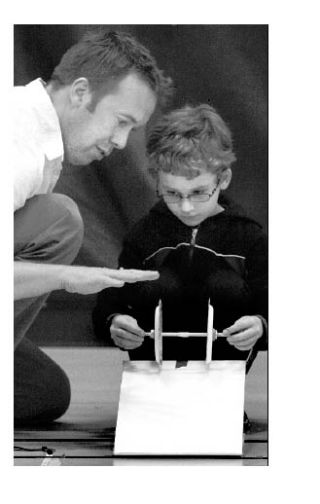
Third-graders studied momentum and built a two-wheeler out of two paper plates, a pencil, washers and some clay. They rolled them down a ramp and the builder whose wheeler rolled the farthest attended the olympics.
“The kids are very intense and biting their lips,” Bullock said of the wheeler trails. “They’re in to it.”
Fourth-graders focused on isolating variables in a system. They built catapults out of a milk cartoon, toothpicks, rubber bands and a small paper cup and then launched a marshmallow. Distance was the deciding factor in this experiment.
Fifth-graders, also isolating systems, built bridges out of 50 milk-straws and masking tape. They then placed a felt chalkboard eraser on the bridge and the olympian hopeful was determined by the distance between the upright supports and the sag of the bridge. The student with the highest score won the classroom competition.
On Thursday, aside from sink or float, the students reconstructed the projects from scratch. Boat floats and paper rockets had 15 minutes to prepare, two-wheelers were given 10 minutes, catapults 20 minutes and bridge constructors had 30 minutes.
Each olympian hopeful was given a green participation ribbon and the top three on Thursday received a blue, red or white ribbon of their own and got to stand on a bona fide award podium for all the see.
Bullock said in the past boys usually dominated at the olympics, but in recent years it’s been about 50/50 and now the girls have a good showing. NKSD holds the Science Olympics so early in the year is because a lot of kids learn science hands-on and the olympics really pumps them up to explore solving problems.
“The kids get tons of validation of their efforts at the Science Olympics,” Bullock said. “This is just a great start to hands on science. It’s down and dirty get them excited about science.”
NKSD’s been conducting the Science Olympics since the 80’s.
Best of Kitsap