
Rep. Randall’s efforts to bring federal funding to local projects
Published 1:30 am Tuesday, May 12, 2026
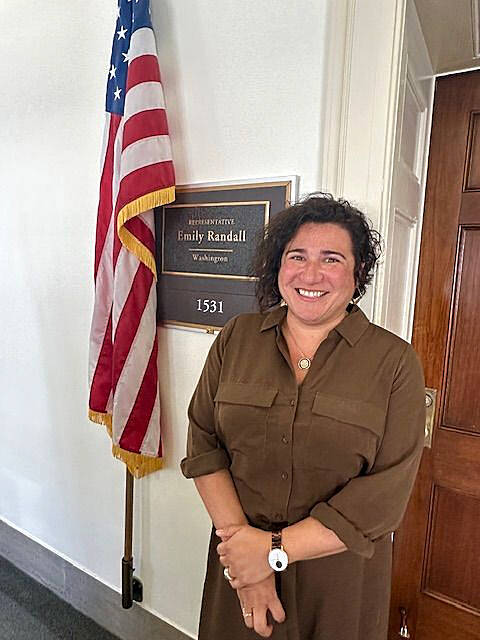
Kitsap News Group freelance reporter Mike De Felice spent a week with the 6th District’s U.S. Rep. Emily Randall (D-WA) in the nation’s Capital. This article, the second in a three-part series, examines the congresswoman’s efforts to direct congressional funds to support local community projects. The next installment will look into her proposed legislation to support ferry systems here and across the nation.
One measure of how effectively a U.S. congressperson represents their district is to see how much federal money they secure to fund local projects.
On that count, 6th District U.S. Rep. Emily Randall (D-WA), gives herself a grade of “B-plus” in efforts to fundraise for her constituents. “I think that there is always room to grow,” the first-term congresswoman said.
This year, Randall helped secure nearly $18 million in an Appropriations package for 15 community projects across the 6th District, which includes Kitsap County, the Olympic and Kitsap peninsulas, Aberdeen, Gig Harbor, Port Townsend, Port Angeles, and parts of Tacoma.
“This money translates into real change for people, whether it’s emergency response systems or drinking water, or bus training facilities,” the congresswoman said. “Budgets for local governments are under real stress and being able to deliver these community-directed spending projects home is huge,” she said. Projects in Kitsap County that Randall helped provide congressional funding include a facility for low-income patients receiving aftercare following hospitalization, a bus driver training center and a ferry terminal upgrade.
It’s noteworthy that each project Randall sought funding for got the go-ahead for federal money from the Appropriations Committee.
She said her office received over 40 submissions for funding, which were pared down to those that met federal requirements. Next, they were vetted by her office. “Almost everyone on the team, including myself, has a hand in this process,” Randall said.
Funded projects
Randall’s efforts helped secure more than $1.7 million for Peninsula Community Health Services (PCHS) to build a medical respite center on 6th Street in Bremerton.
“Medical respite is a program to accept patients who are largely coming from the hospital system, who are housing unstable and not able to be discharged from the hospital because they have nowhere stable to go to recover from their hospitalization,” PCHS CEO Jennifer Kreidler-Moss said.
The facility, located at the former site of the Kitsap Rescue Mission, will have 22 rooms to care for low-income patients recovering from hospital procedures. Patients will come from Kitsap, Mason and rural Pierce counties.
“We will be able to see them daily for their medical condition and offer daily behavioral health services. We will also be able to work on long-term planning to see if we can help them find a safe place to go to after they recover and get employment,” Kreidler-Moss said.
Set to open in August, the center will be one of the largest medical respite centers on the West Coast. “It is great that it is in our region and we’ll be able to serve the needs of our state from our little corner of the world,” the CEO said. “As a state senator, Randall was an incredible partner for community health and has continued to advocate in Congress,” Kreidler-Moss said.
In March, Randall helped garner $15 million for construction of a Kitsap Transit regional bus-driver training center. Senators Maria Cantwell and Patty Murray of Washington were also responsible for obtaining the funding from the Department of Transportation’s Federal Transit Administration.
“This facility is necessary so that we can enhance public safety and to help us recruit outstanding employees,” said Steffani Lillie, Kitsap Transit service and capital development director.
The training center, slated to open in 2028, will be the first of its kind serving Kitsap, Pierce, Mason, Jefferson, Clallam and Lewis counties. Drivers from those areas will use the facility, she said.
Plans call for the center to be built on an eight-and-a-half-acre land parcel, adjacent to the Puget Sound Industrial Center. Classrooms, a simulator training room and office spaces will be housed in the 10,000-square-foot building. The project will cost $33 million, which includes property acquisition and construction costs.
“We couldn’t have achieved this without (Randall’s) continuous support and leadership,” Lillie said. “She knows our service area well and the vital role transit plays to support the major employers like the Puget Sound Naval Shipyard, as well as the families in our community,” Lillie said.
Washington State Ferries was awarded $850,000 in federal money to help replace the Southworth Ferry Terminal building and its timber trestle.
The terminal, built nearly 70 years ago, serves 850,000 passengers annually. The dock is used by car traffic on the Southworth-Fauntleroy-Vashon route and foot traffic on Kitsap Transit’s fast ferry to downtown Seattle.
The replacement will add 75 years of lifespan to the trestle, improve resiliency and stormwater treatment, and help advance other projects to improve bicycle, pedestrian and vehicle mobility, per Randall’s office.
Work on replacing the terminal building is slated to be finished by 2028. Construction on the new dock is expected to be completed in 2031.
The Central Kitsap Wastewater Treatment Plant upgrade netted $1 million to retrofit the 45-year-old system, thanks to Randall. The upgrades are expected to allow the county to maintain public health and water quality standards.
New funding requests
In the next round of House Appropriations fundings, the lawmaker is seeking federal money for a pair of fire engines and infrastructure improvements for the county.
Her biggest ask is for $8.9 million to build a roundabout in Kingston. The funding would be used to construct a multi-lane roundabout at Hansville Road Northeast and Little Boston/Delaney Road, a location said to have a record of crashes.
Another request seeks $1.5 million for Kitsap Transit’s intermodal passenger ferry terminal in Port Orchard. The funding would be used for structural repairs to the maritime station, site of 261,000 passenger trips annually. Improvements are expected to extend the life of the existing terminal.
The congresswoman is also seeking $1.1 million to help cover rehabilitation of the Port of Bremerton’s sewer infrastructure. The port’s sewer system reportedly supports 39 businesses and 2,300 jobs at both the industrial park and airport.
In addition, Randall applied for federal funding for two fire engines for South Kitsap Fire & Rescue. The $975,000 request will cover a portion of the purchases. The fire units will be designed to work in rural areas where residents live on larger parcels of land with driveways and access points that can be challenging, said Joshua Hurguy, SKFR’s deputy chief of administrative services.
“The units would have the same capabilities of a traditional fire engine but have a shorter wheelbase. They are a little bit smaller and able to get into tighter places,” Hurguy said.
The new units would operate out of Station 12 in Olalla and Station 14 in Burley.
“We are excited that Congresswoman Randall was able to understand the challenges we face as a fire service in keeping our apparatus up to date and is helping support us,” he said.
Should the Democrats regain a majority in the House at the midterm elections in November, Randall believes federal funding will increase for local projects as constraints imposed by Republicans are lifted.
“We will be able to release the money for green energy projects and reinstitute some funding buckets that aren’t eligible right now,” she said. There are also barriers that hopefully can be removed to get money to key things like nonprofits and housing projects, Randall added.

Best of Kitsap