Port Orchard youth explore Latin jazz at camp
Published 1:30 am Tuesday, August 26, 2025
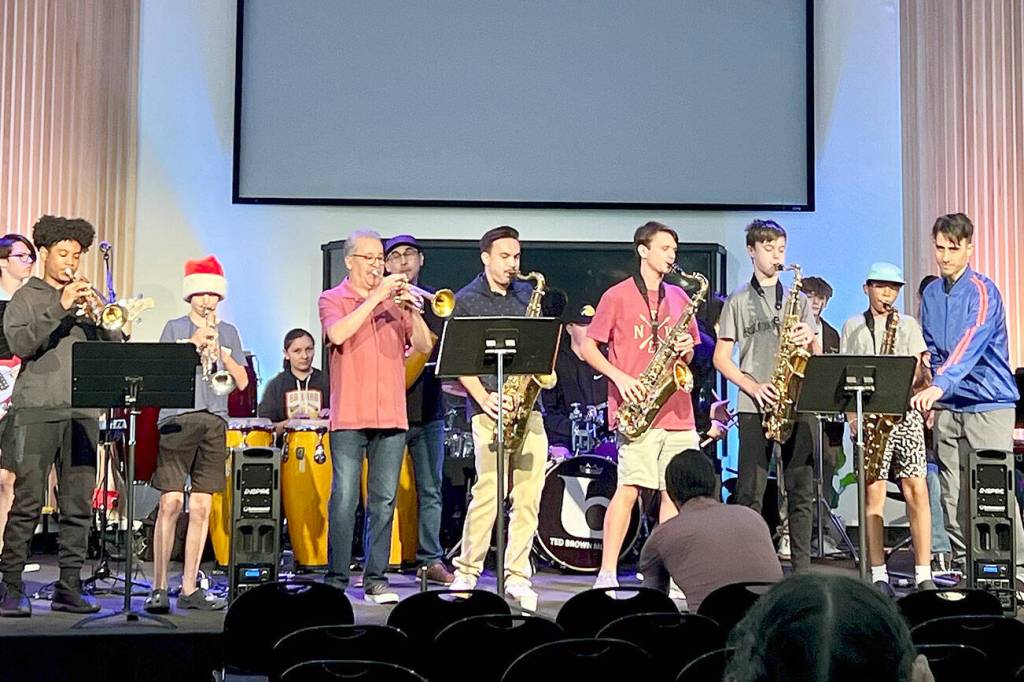
For middle and high school students in Kitsap County, music opened doors to worlds beyond their classrooms, and the Latin American Jazz Camp in Port Orchard was designed to do just that.
The camp was led by internationally acclaimed musician Bobby Medina and his ensemble Pablo Elorza on bass, Gabe Hall-Rodrigues on piano and accordion, Santiago Hernandez on drums, Willie Garza on percussion, and Conrad Medina on saxophone and flute. The three-day program at Sidney Commons Aug. 20-22 offered students not just lessons in rhythm and melody, but a chance to explore the cultural roots of Latin jazz and the art of collaboration.
“This is an international project that has been in existence for about 15 years,” Medina said. “Some of the people are in South America. Some of us are in different states in the U.S., and we get together every so often and perform.”
The camp’s curriculum was designed to give students a new musical “language.” They learned rhythms from a cha-cha by Tito Puente, a bossa nova piece by Quincy Jones titled Soul Bossa Nova, and Cuban classics like Guantanamera. Medina said these styles taught young musicians to recognize different accents and nuances, much like learning to speak a foreign language.
Students said the camp gave them a chance to stretch their skills.
“It was really fun and educational,” said Griffin Brown, who played bass guitar.
“It was fun learning different ways and styles of music to play on the drums,” added percussionist Reese Rodriguez. “It’s different from the traditional.”
For Ella Moss, the camp was her first experience performing in an ensemble. “I loved it here — this was my first time playing with a group of people,” she said. “I loved trying different drums that I might not get to play again.”
“Latin music has found its way into all sorts of music, whether it’s jazz or pop music,” Medina said. “It’s kind of like learning a little bit about another language and learning how to communicate. It helps them see the world in a different way.”
Medina said mentorship was central to his work. Growing up, he was guided by renowned trumpet player Bobby Shew, who encouraged him to pursue music despite the challenges of the industry. Medina carried that philosophy into teaching. “Sometimes one lesson can change the trajectory of someone’s life,” he said.
That spirit of mentorship was echoed by Melissa Martin, a piano student. “I was the only person who played my instrument, so I got a lot of one-on-one help,” she said. “It was an amazing and fun experience.”
Members of Medina’s ensemble also shared what the experience meant to them ahead of the camp’s closing.
“It doesn’t matter if you don’t speak English or Spanish or whatever, you can play music, you can go anywhere in the world with people,” said Hernandez.
Hall-Rodrigues said music builds on itself in powerful ways. “When you start, you know, you have this love for an instrument or for a style of music and as you go on that journey, you just get more and more enriched with experiences and friends and culture and food and all these really amazing things that I think make life worth living.”
Medina said the camp was a two-way street. “Having these kids here and having them show us things and let us show them things has been such a great experience,” he said. “And you know, I’ve learned more than I thought I was going to from these kids.”
Garza added, “I’m looking forward to all these seats next year, just to be completely full.”
The camp was offered at no cost to students, ensuring accessibility regardless of economic background. Medina said he hoped the program would inspire students to continue exploring music and help position Port Orchard as a cultural hub.
Steve Sego, of Waterman Mitigation Partners, said the growth was clear. “I think they had a great time. The first day, they were scared, but now they are playing and laughing,” he said. “Toda,y there is so much that young people are exposed to that isolates them. These kids are now experiencing something that is connecting them and developing more passion in them.”
The camp concluded with a mini concert for parents and grandparents who also saw the benefits.
Barbara Beck, grandmother to student Ryker Wood, said the camp gave her grandson valuable perspective. “I think it was an opportunity for him to own his skills and see what it is like for somebody who has had some experience to get a clear picture of the whole process,” she said. “To work with someone who’s had some success gave the kids the sense of confidence that they can have success too. The ability to play music with other people is huge.”
“Quincy Jones was about education and mentorship,” Medina said. “We feel like we’re trying to help keep that tradition going. This is something really, really special.”