
How to master the art of ‘failing upward’
Published 1:30 am Friday, August 14, 2026
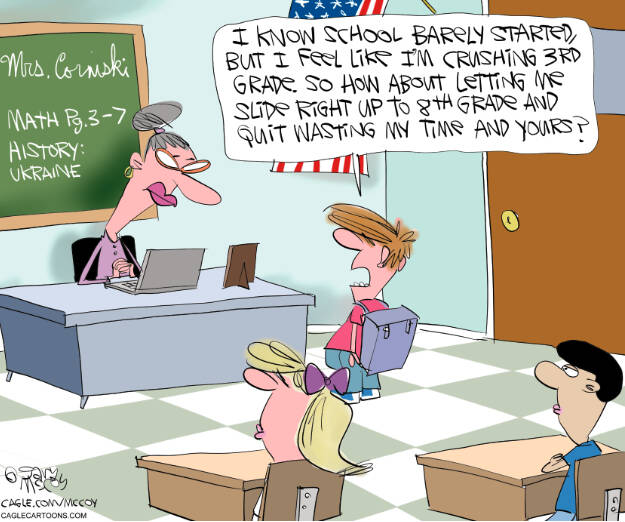
I’ve been thinking about the Dunning-Kruger effect, and I’m pretty sure I’m an expert on it.
For those of you who don’t know, the Dunning-Kruger effect is the idea that people often overestimate how competent they are.
This explains why I was most self-assured at the age of 16, when I believed I knew everything about politics, relationships, and how to do laundry (answer: get Mom to do it).
In the years since, I’ve mastered the art of being slightly wrong with absolute confidence. I consider this failing upward.
This is how I once assembled a bookshelf without reading the instructions.
Okay, so the instructions were actually a reasonable four pages in length, complete with diagrams and a phone number to call if I needed help.
But whoever wrote them obviously assumed I’d need significant assistance to construct a simple frame for the complete works of Alexandre Dumas, Thomas Hardy, and Dav Pilkey.
I just can’t take that kind of condescension.
Halfway through building my bookshelf, I had created something that could not legally be described as furniture, at least by the more quibbly lawyers among us.
The bookshelf eventually collapsed under the weight of a single paperback.
But not before I had taken pictures and sent them to all my friends asking for their support as I angled for the presidency of IKEA.
For those wondering, the paperback was totally an Alexandre Dumas. Unabridged. I promise.
See, I don’t make mistakes. I create leadership opportunities.
Often the leader is myself. What can I say? The role is forced upon me.
Take meetings. As an intern, I learned that smiling and nodding as my boss talked and frowning when my coworkers complained was not helpful.
Not for my career, at least. No, my company rewards “initiative.” It rewards “boldness.”
It rewards a 14-minute speech I made about our component architecture despite not knowing what “component” or “architecture” meant.
Separately and together. Or maybe it’s the other way around.
Yeah, I don’t have a dictionary on my bookshelf. But that hasn’t stopped me so far.
I got promoted to the role of Software Engineer I, which is basically “intern with parking privileges.”
But I’m angling for “intern with parking privileges and a snack allowance.”
I’ve been practicing my speeches. Next week, at the company all-hands, I intend to launch into a panegyric (if panegyric is the word I want) about the turbo encabulator we’re building.
Or not building. I don’t recall what our company priorities are. But if they hired me, they must want me around, and getting me means getting my technobabble, too.
Despite my bookshelf-building know-how and my verbal skills, I can’t say I’m an expert in everything.
For one, my cousin’s friend’s daughter’s adopted uncle says that it’s illegal. False advertising or something.
I don’t get why that applies. I’m not strictly advertising anything. But I guess we all have to follow the law, or at least I do, to set an example for the children.
For two — in case you’ve forgotten, I am talking about not being an expert in everything — I am modest. In fact, I’m the most modest person I’ve heard of.
Modesty: that’s my slogan. Along with “The Few. The Proud. The Marines.”
Okay, so maybe I didn’t invent the Marines’ slogan. But I could have.
Sometimes, though, I have to admit that the Dunning-Kruger effect bites back.
Sometimes, you are forced to confront the possibility that expertise requires something more than enthusiasm and a strong speaking voice.
I’ve been thinking about that a lot lately.
And I’m pretty sure I’m right.
Copyright 2026 Alexandra Paskhaver, distributed exclusively by Cagle Cartoons newspaper syndicate. Alexandra Paskhaver is a software engineer and writer. Both jobs require knowing where to stick semicolons, but she’s never quite; figured; it; out. Feel free to contact her at alexandra.paskhaver@gmail.com



Best of Kitsap