
Kitsap navigating budget challenges ahead of December deadline
Published 1:30 am Wednesday, October 15, 2025


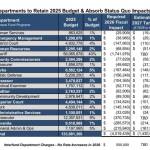
In mid-September, the Kitsap County Board of Commissioners received presentations from county departments about their proposed budgets, as part of an estimated $8 million countywide shortfall, which the county aims to reduce to $4 million by implementing a 3% reduction across all departments for fiscal year 2026.
Kitsap County will need to approve a budget by the first Monday in December, per state law.
The county is facing a structural deficit, which means the ongoing cost of providing services is growing faster than its revenue base. The imbalance has been growing in recent years due to multiple factors, including a 1% property tax growth cap, flat sales tax growth, and rising insurance costs. Jail medical costs have increased 217% since 2018, Kitsap County spokesperson Krista Carlson said.
The three departments that will face the largest budget shortfalls include: Sheriff’s Office $1.74 million (3% of its $58.1 million budget), Prosecutor’s Office $370,735 (3% of its $12.4 million budget), and Juvenile Services $285,570 (3% of its $9.5 million budget), Carlson said.
However, all departments are facing approximately the same 3% reduction, with the dollar amount varying based on the size of each department’s budget, which totals about $4 million in required fiscal impacts across all General Fund operations, she said.
All 22 Kitsap County departments and offices within the General Fund will be impacted by the budget constraints, including three internal services departments – Capital Facilities, Equipment Rental and Repair Fund, and Fleet Management, Carlson said.
The board of commissioners also supports spending up to $2 million in reserve funds to cover ongoing expenses, county budget manager Kris Carlson said.
“The Board recognizes that this action is not sustainable; however, we have healthy reserves that can offer us more time to be conservative. Sales tax is our largest revenue stream and subject to the most economic volatility. If sales tax performs stronger than our conservative forecast, we may not need to spend reserves in 2026,” Kris Carlson said.
Several departments have also exceeded their 3% reduction targets, including administrative services, juvenile services, commissioners’ office and the clerk’s office, he said.
This follows a June 9 countywide hiring freeze, which runs until Dec. 31. Per state law, counties are required to adopt a balanced budget, Krista Carlson said. Kitsap County says personnel expenses represent more than 70% of the General Fund budget. More than 25 positions will remain frozen and ultimately eliminated starting Jan. 1, 2026, per Krista Carlson.
“The freeze is designed to help manage budget pressures through natural attrition — as positions become vacant, leaving them unfilled creates ongoing savings,” she said. To date, Kitsap County has saved an estimated $1.4 million as a result of the hiring freeze, with the full fiscal impact still ongoing and will depend on the number of vacant positions through natural attrition since the start of the freeze, Krista Carlson said.
“The hiring freeze is one component of the county’s broader strategy to address the projected $8 million shortfall for fiscal year 2026. Departments are also developing spending reduction plans to demonstrate their ability to absorb cost increases in the 2026 budget,” she said.
Krista Carlson said it’s also a best practice for the county to maintain a balanced budget. In the event of expenses exceeding revenue, the county would need to take corrective actions such as further spending reductions, service cuts, use of reserves, or seek new revenue sources where legally permissible.
“The across-the-board approach ensures that all departments share proportionally in addressing the structural budget deficit, rather than targeting specific services for deeper cuts,” she said.
On Oct. 1, the Kitsap County Board of Commissioners reviewed a recent community survey, which looked at livability for Kitsap County residents. The survey was conducted by Polco, a Wisconsin-based software company which uses data to better inform local governments. The survey looked at multiple factors including: economy, safety, and mobility.
“More than half of residents expressed a preference for increasing sales taxes to maintain current service levels, and about two and five indicated preference for increasing property taxes if the county were to consider a tax increase,” Jason Neumeyer, a director of survey research at Polco said.
Krista Carlson said the county plans to use the survey data to inform decision-making to help determine which services and priorities are most important to residents.


Best of Kitsap