
Training for a better future in Bremerton
Published 3:37 pm Friday, August 13, 2010
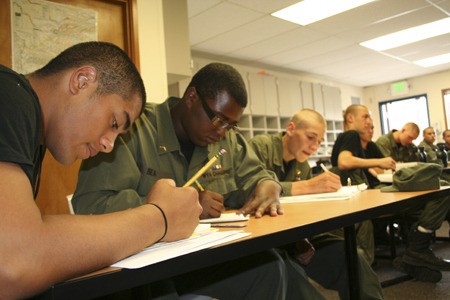
The 23 teenage boys marching into Lynn Caddell’s U.S. history class, all with identical uniforms and backpacks, were perhaps not meant to succeed in school in the eyes of some.
They are high school drop-outs, or near drop-outs, but on Tuesday, as they analyzed the Bill of Rights and delved into the archaic language, they showed an interest they may have never shown in school before.
“It’s amazing,” said Caddell, the Washington Youth Academy’s new principal and social studies teacher, as the cadets marched out of the classroom.
The Youth Academy is a change of scene for Caddell, who is spending his first session as the full-time principal. Previously, he was a part-time planning principal for the Youth Academy while also acting as principal for Renaissance High School, Bremerton’s alternative high school. At Renaissance, where he was principal for four years, he saw the number of graduates double to 50 graduates this year compared to last year’s count. Like the Youth Academy, Renaissance is a program for kids who didn’t excel in a traditional high school.
But, unlike at Renaissance where students have the flexibility of learning at their own pace and the focus is more on community and relationships, the Youth Academy is a more “intensive intervention” for at-risk youth, Caddell said.
Cadets apply to the Youth Academy voluntarily — many said they were referred to the program by former cadets. It’s an interventional program, but one in which students recognize their poor choices and seek a better future.
“The single thing they have in common is they want to turn that around,” Caddell said.
The 23 cadets are among the 130 teens, ages 16 to 19, who are attempting an about face at the Washington Youth Academy in Bremerton, the only state-funded residency program in Washington.
It is week four of the voluntary 22-week program aimed at getting kids back to high school, and it is the fourth class to come through the program. The cadets fidget in class and sometimes have to remind each other not to talk without permission, but Caddell already sees progress in the teens in a place where he says they can press the “restart” button on their lives.
“These kids have hardly finished anything in their life,” Deputy Director Larry Pierce said. “Finishing something is important.”
The Washington Youth Academy, part of the National Guard Youth Challenge Program, operates in what employees call a “quasi”-military style. Caddell said it takes the aspects of military life that could benefit kids in need of self-esteem and structure — the customs, courtesies, routine and discipline — and uses them to foster respect and life skills.
“It really all comes down to developing habits in these kids to help make them successful,” he said.
Not all of the staff and faculty have a military background — some are from business, construction or law enforcement — but the structure helps develop discipline and remove distractions to help at-risk youth focus and earn up to eight high school credits to take to their home schools.
“Right now they’re at risk for not becoming productive citizens,” Director Gordon Toney said. “We want to get them in the position to become productive citizens.”
The cadets readily admit to their past faults.
“I’m really sick of treating my family and other people I care about poorly,” said Lindsay Carter, 17. “Coming here would teach me how to work as a group. I wanted to make my mom proud of me for once.”
Faatasiga Tusi, 17, said the Youth Academy offers an opportunity to give teens a new start.
“It’s not because of our past, we’re here because of our future,” he said. “Some of us messed up and did the wrong things. We look at this like a second chance in life.”
Dalton Riha, 17, said he had several friends who came to the Youth Academy who were troublemakers before the program, but came back as more responsible people. He himself was lazy and needed more discipline.
“I just finally got the courage to fill out that 50-page application,” Riha said. “I just needed a better change of environment.”
Like in a military environment, cadets wake up at 4:45 a.m. to lights and a whistle.
“It’s a pretty big rush to get out of bed,” said Forrest Dougy McMurrin, 17.
They must make their beds up to standard, or suffer the “tornado” — in which the cadre staff messes up everyone’s bed and tosses other items about the barracks as a punishment — as the second-floor boys would see Tuesday.
The rest of the day is filled with physical training, seven class periods, timed meals and latrine calls and daily chores. After the first two weeks of the program – the “pre-challenge,” filled with physical fitness and teamwork training — cadets are allowed to call home on weekends and get two trips home during the 22-week session.
Cadets complain about the two-minute showers, waking up early and the high standards for making a bed. It’s been hard adjusting to the demands of the rigorous schedule and they sometimes take the cadres’ shouting personally.
It was something that 19-year-old Godfrey Meafou didn’t expect.
“I was like, ‘I’m out the door,’” he said of the “pre-challenge” shock.
But Caddell said that about halfway into the program, cadets begin to internalize the habits and routines developed at the Youth Academy and become more self-motivated.
“That’s when we know we’ve made some changes and some progress,” Caddell said. “By forcing them to respect others, over time they respect themselves.”
And that’s a big feat for young people whose previous accomplishments may have been few.
“A lot of them have never been given any praise before,” Pierce said.
Post-graduation, cadets are tracked by mentors for an additional year. Between the Youth Academy’s three other graduating classes, about 80 percent of accepted applicants see the program through completion. Of the 204 graduates of the first two classes in 2009, 70 to 80 percent of graduates are still in school, found work or joined the military, said Amy Steinhilber, recruiting, placement and mentoring coordinator. Most go back to high school or enter vocational training.
In addition to the incentive to graduate, several cadets, including Meafou, said they just want to make their mothers proud.
“It’s the least I can do for the woman who brought me into this world,” he said.