Kitsap Harvest tackles food insecurity with Grow-A-Row program
Published 1:30 am Tuesday, September 16, 2025
An effort to fight food waste and provide fresh produce to families in need is growing across the county through nonprofit Kitsap Harvest’s community-based programs.
“We fight food waste but also fight insecurity at the same time,” said Laurie Davis, Grow-a-Row coordinator for Kitsap Harvest.
The organization has been operating since about 2017 and became a nonprofit during the pandemic in 2020. One of its cornerstone efforts is the Grow-A-Row program, which encourages home gardeners to donate extra produce to help feed neighbors who may not otherwise have access to fresh fruits and vegetables.
“In 2018, it’s my understanding we started gleaning fruit trees and then in 2018 we were able to add the Grow-A-Row program,” Davis said. “We hired an AmeriCorps VISTA, Harvest VISTA, her name is Katie Allen, and (she) still works with us through the (Washington State University) Extension Office. She was originally a VISTA volunteer for us and she’s the one who really got our Grow-A-Row program established.”
The program started at local farmers’ markets, where community members were encouraged to buy extra produce to donate. Over time, it shifted to give home growers a central drop-off spot for surplus food.
“The point of the Grow-A-Row program was to give people an outlet, especially home growers, like people who are growing in their garden, a place where they could put those extra zucchini,” Davis said. “What we could do with that is give that to people in the community who would otherwise not have access to it.”
Today, donation stations are hosted across the county. Kitsap Harvest operates no-host stations in Port Orchard, Bremerton, Poulsbo and Kingston, where gardeners can drop off produce, seeds or plants. Stations are also available at the Port Orchard and Bremerton farmers’ markets.
“We love the farmers’ markets because you’re getting people out into the community, it’s a community involvement event, it’s a central location,” Davis said. “It’s easy to get to and they can talk to us about how they can become volunteers.”
The food collected goes directly to community partners, such as Coffee Oasis, the Boys and Girls Club, senior centers and food banks.
“That food immediately gets put into the hands of people who can use it before it goes to waste,” Davis said.
Kitsap Harvest’s Glean Teams also harvest fruit from farms and backyard trees. Volunteers are allowed to take home a portion of what they pick as thanks for their work, while the majority is distributed to shelters, senior housing, health clinics and other organizations.
“I always tell people there’s a lot of food in Kitsap County, it just sort of gets stuck in places and it kind of needs a lift, it needs a ride, to get where it can be useful,” Davis said.
The nonprofit serves approximately 1,500 people biweekly through 20 distribution sites. Food is often displayed in a farmers’ market style, giving people the chance to choose what they want, with no requirement to sign up.
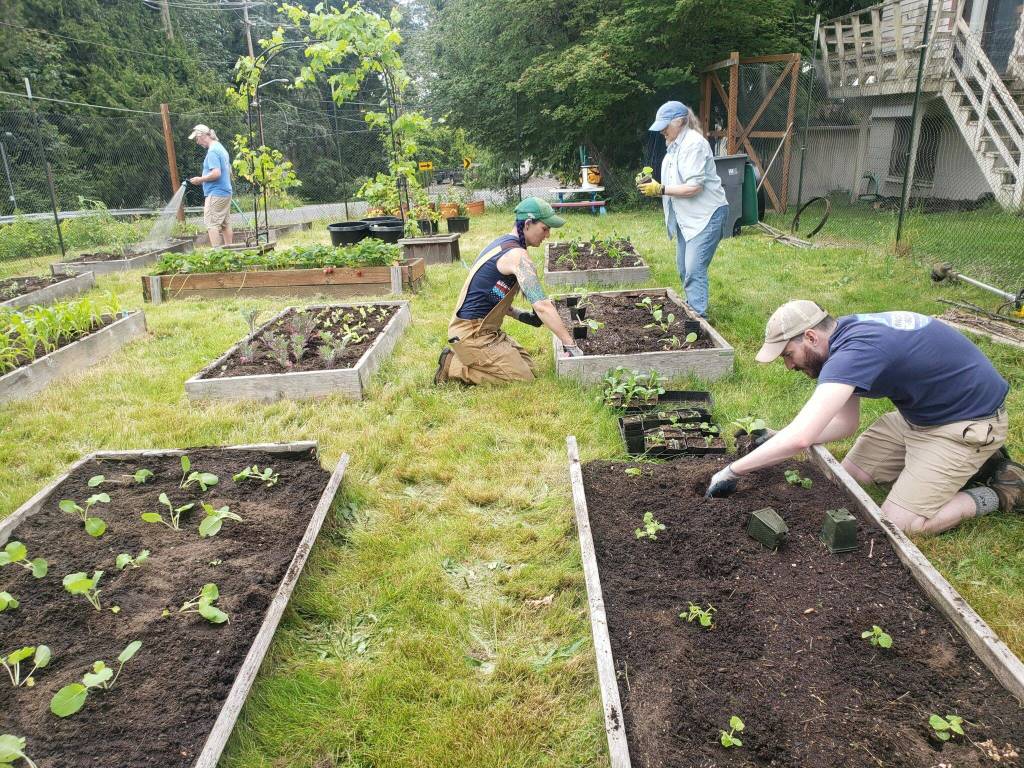
Beyond distribution, Kitsap Harvest also supports community gardens. The organization helps manage gardens at Brownsville United Methodist Church and Howe Farm in Port Orchard. These sites provide education, youth engagement and hands-on opportunities to grow food for those in need.
“Community gardening is something we start early in the season,” Davis said. “We create our own plants. We do a lot of community gardening at Howe Farms.”
From spring tree registration to fall fruit harvests, Kitsap Harvest relies on volunteers to meet the growing demand. Davis said the organization is always looking for more people willing to host donation stations, glean fruit trees or help sort food at its Bremerton warehouse.
“Summer to fall is the busy season for Kitsap Harvest and there are a lot of food donations coming in, a lot of food distribution,” she said. “But then we also have a whole team of people at our Bremerton warehouse that meet on Tuesdays and Thursdays to sort the food and make sure that it’s top quality.”
The effort ensures nothing goes to waste — top-quality produce is distributed to families, while lesser-quality food is given to local animal farmers.