
Buddhist peace pagoda near Bangor now complete
Published 1:30 am Monday, May 25, 2026

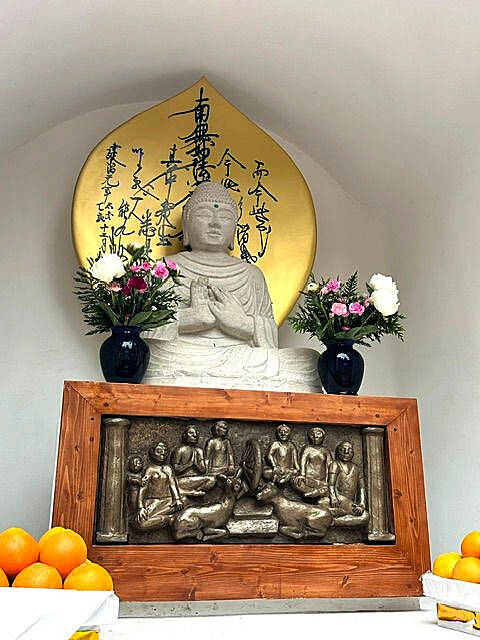


A Buddha, carved from limestone, stands as the centerpiece of the Buddhist peace pagoda that was formally dedicated May 23 near Poulsbo.
The shrine – a symbol of world peace – is located just steps from the barbed wire fence of Naval Base Kitsap-Bangor, the West Coast hub for nuclear submarines.
“Looking back, this project began roughly half a century ago,” said Japanese Buddhist Monk, Reverend Senji Kanaeda, of Bainbridge Island’s Nipponzan Myohoji Buddhist temple. “That it has finally come to fruition after many twists and turns fills me with deep emotion, including a sense of its significance and purpose.”
Kanaeda has been a driving force behind the pagoda. He has organized several peace walks and is the son of Japanese peace activist parents.
The pagoda, or stupa, was developed jointly by the local Nipponzan Myohoji temple, which advocates for world peace, and Ground Zero Center for Nonviolent Action, a group that opposes nuclear weapons.
An estimated 200 attended the debut of The Pacific Northwest Peace Pagoda. The Asian shrine contains the relics, or ashes of Buddha, the founder of Buddhism.
Some 80 Buddhist monks and nuns from around the world, including India, Japan and Mexico, traveled to the Kitsap Peninsula for the dedication ceremony, per organizers.
A Buddhist ceremony, referred to as Rakkei Shiki, marked the dedication. Chanting of sacred Buddhist scriptures, prayers for peace and blessings by monastics were part of the event. Indigenous and Japanese taiko drumming also took place.
The pagoda is a 42-foot-tall dome structure, topped by a spire or sōrin. It sits on a 3.8-acre parcel of land owned by Ground Zero Center on Clear Creek Road NW.
Bainbridge Island architect John Paul Jones developed the final plans for the pagoda, working off the initial design by Keizo Takashita of Osaka. Jim Lyman, of Seabeck, supervised construction. Quaker sculptor Craig Jacobrown, of Bremerton, created relief panels for the pagoda that depict scenes from Buddha’s life.
Placement of the pagoda alongside the military base was no accident.
“While the contrast and opposition between the (base and pagoda) are striking, we believe in the awakening of the people on both sides and in the convergence point of peace. This modest symbol will contribute to that end,” Kanaeda said.
Capt. Alexander Baerg, commanding officer of Naval Base Kitsap, said of the pagoda launch,”(The base) maintains a strong and professional relationship with our neighbors in the community. We respect the First Amendment rights of all individuals and groups to peacefully assemble and express their beliefs. As the Pacific Northwest Peace Pagoda opens, our personnel remain dedicated to our primary mission: ensuring the safety and security of our service members, civilians, and families within the region.”
Completion of the pagoda took nearly 50 years. During construction, the project endured bouts of controversy. Progress was initially halted due to the denial of the original building permit, which led to litigation. Over the years, the site also suffered two fires – one electrical and the other suspected arson, Kanaeda said.
A public opening of the pagoda will take place June 20. Following that, those wishing to visit the property can make arrangements with Ground Zero.
The Nipponzan Myohoji sect has constructed over 80 peace pagodas around the world. The first one was erected in 1950 in Kumamoto, Japan, following World War II. The Kitsap pagoda is the first one on the West Coast. Others in the U.S. are in Massachusetts and New York.


Best of Kitsap