West Sound Academy students debut first play under new leader
Published 1:30 am Tuesday, November 4, 2025
For Thalia Wolff, leading West Sound Academy’s theatre program feels like a full-circle moment.
Wolff, who grew up in Poulsbo and spent her youth immersed in Kitsap County’s performing arts scene, returned home to guide a new generation of young performers.
“I was a participant in a local community theater. I danced with Galletta School of Dance and Performing Arts. I worked with CSTOCK and the Jewel Box Theatre. I did theater in high school at Klahowya,” she said.
For Wolff, who earned a bachelor’s degree in literature and theatre from Reed College and a master’s degree in theatre education and applied theatre from Emerson College, returning to lead West Sound Academy’s grades 6 through 12 program is both personal and purposeful.
“When I was growing up around here, I really appreciated all of the different creative outlets that existed throughout Kitsap County for youth and adults to collaboratively create and develop stories,” she said. “It sustained my soul and kept my heart and mind open to new ideas and different stories. So to return with the knowledge that I’ve gained through my experiences – and to add to this great conversation that is the creative scene in Kitsap County — it’s a great source of pride for me.”
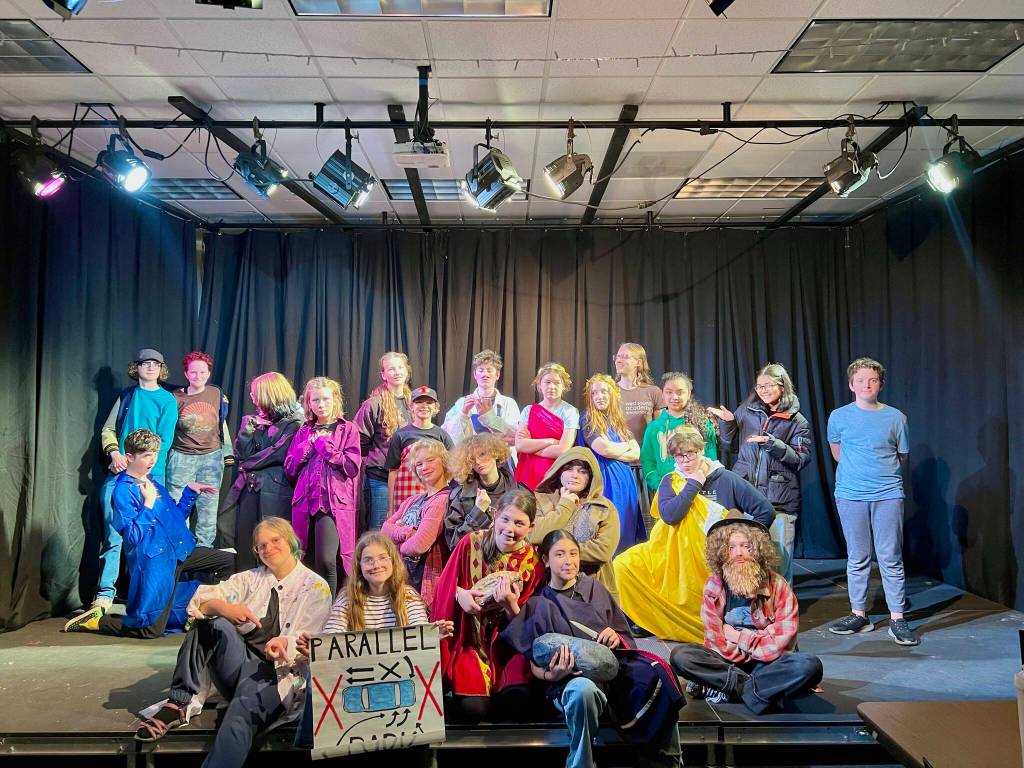
Wolff’s first production at West Sound Academy is as imaginative as its title: How to Make a Sandwich in 20 Easy Steps When All You Have Is a Time Machine, written by Brendan Main. The play, a theater-for-young-audiences piece, will tour several local elementary schools, including Suquamish Elementary, David Wolfle Elementary, Ordway Elementary, and The Island School.
“I knew that I wanted at least one of my first productions to be a theater-for-young-audiences play because I wanted to create bridges in the community,” Wolff said. “I wanted my students to get the chance to share their creativity and their work with a big audience.”
For some students, Wolff’s arrival made all the difference.
“I wanted to do theater for a long time, but I was only able to do one play before we had to move again— my dad used to be in the military,” said 8th grader Fin Daley. “When Ms. Wolff became the theater teacher, I felt a lot more comfortable auditioning for plays here. It’s become one of my favorite things.”
Daley, who plays multiple characters in this year’s production, said she’s enjoying the creative challenge of taking on several roles, including a dancing crab.
Along with the student actors, several behind-the-scenes crew members have played a key role in bringing the production to life.
“I’m not an actor, but I’m the head costumer,” said 8th grader Lucy Guerechit. “I really like fashion, so I decided I’d enjoy making costumes. That’s kind of what drove me to join.”
Guerechit said she designed and sewed most of the costumes herself and is looking forward to seeing her work on stage. “I can’t wait for the audience to see all my hard work — and everyone else’s,” she said.
“I’ve been doing theater for a while, and it’s just something that I really enjoy,” said 10th grader Juniper Wolff. “I do a lot of tabletop role-playing outside of school, so this is just something that really fits me. I was particularly interested in this play because of the possibility of touring, which I’ve never done before in my life. I thought that would be really fun to try. And then we ended up having two casts, which was also really cool.”
Juniper Wolff said she plays the character who invents the time machine in the play.
“They’re sort of an eccentric, mad scientist teenager who just made this time machine and wants their friend to be into time travel,” she said. “I usually play pretty logical characters, so it’s been really fun to play someone energetic and kind of reckless.”
The production, Wolff said, was inspired by her experience directing The Miraculous Journey of Edward Tulane at Emerson, where she saw firsthand the impact of theater on young audiences.
“This play presents some really interesting questions about history,” Wolff said. “It encourages historical curiosity — asking how history is told, how perspective changes it, and how we interpret it to inform our present. It’s objectively silly at times, but it inspires a desire to know more and to dig deeper.”
The new show features students from all seven grades at the academy — a first in recent years.
“I wanted my first play at the school to be one where anyone who wanted to could be involved,” Wolff said. “More than a quarter of the school showed up to audition, which was incredible.”
To foster collaboration across grade levels, Wolff designed a unique two-cast model in which each student shares a role with another performer.
“There’s no sense of competition about it, because they’re both guaranteed an equal number of performances,” she said. “It creates camaraderie and mentorship between students.”
Rehearsals also emphasize ensemble-building and creativity. Wolff incorporates check-ins, team-building games, and collaborative design challenges.
“One of our first tech days, several students worked together to figure out what a time machine actually looks like and how to create it in such a way that we can take it to schools,” she said. “When approached as opportunities for play and growth, it gives students’ creativity a chance to shine.”
Beyond the upcoming tour, Wolff hopes the program will instill life skills that extend beyond the stage.
“Theater is about empathy,” she said. “It’s about seeing into other people’s stories, finding yourself in a role that’s different from you, and envisioning other worlds.”
Looking ahead, Wolff envisions a program that is increasingly student-driven and connected to the wider community.
“My hope is to push toward a program that feels student-centered in as many ways as possible,” she said. “The next project after this will be a festival of new short works written, directed, and designed by students. Everything that comes out of that festival will be something birthed from a student’s mind.”
The program also plans to explore site-specific and outdoor theater. In the spring, students will stage Radium Girls at the Port Gamble Theater.
“I’m trying to build as many different bridges and entry points into the process of theater as I can,” Wolff said. “Every year, we’ll try something new.”