
A look at the history of vintage clocks around Kitsap
Published 1:30 am Tuesday, April 14, 2026


As smartphones display the time at a glance and wrist watches readily show the passing minutes, one question rarely asked anymore is, “Hey, do know the time?” Long gone is the era when townsfolk had to look at the town square clock to learn the time.
The practical value of vintage public clocks may have lessened over the decades, but Kitsap County still boasts a host of old-fashioned timepieces – some stand on the sidewalks while others shine down from towers to serve as a focal point for the community.
In tribute to these timekeepers, here is a look at some of the county’s nostalgic clocks.
Poulsbo
Poulsbo streets echo with the ticktock of history, courtesy of a pair of old-style timepieces that decorate the Norwegian-influenced town.
“Nobody has an excuse to be late to anything in Poulsbo,” quipped Poulsbo mayor Ed Stern, referring to the city’s public clocks.
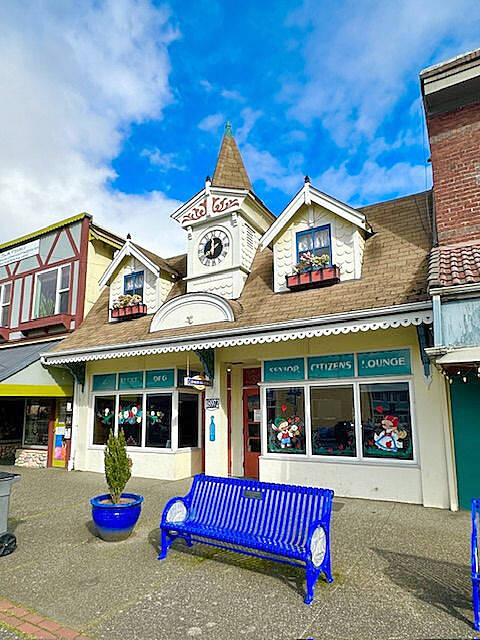
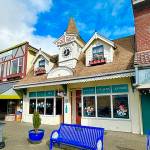
One is embedded in the storefront of the North Kitsap Senior Citizen’s Center. The clock and tower were installed in 1981 by Bill Austin, a 90-year-old whose contributions to the city earned him the nickname “Poulsbo Bill,” or as he jokingly refers to himself, “Over the Hill Bill.”
“I made the clock and tower myself. It’s not any sort of masterpiece or anything. I bought the clock motor from National Clock and attached it to the clock face I made. I built the hands and painted them (with) 23 karat gold leaf. I also hand-painted the numbers on the clock. There’s just an electric motor behind it,” said Austin, a sign painter by trade.
Austin originally volunteered to upgrade the deteriorating interior of the senior center at 18972 Front Street NE. Once he sunk his teeth into the project, he also designed a new exterior to set the building apart. Austin believed the clock would add to the charm of the city.
“We have a historical society here. We have a maritime museum. That’s what people love. I built the clock because it is historic-looking. I don’t do modern stuff,” he said.
Austin donated his time to upgrade the senior center. His efforts paid off, as shown by the positive reactions from visitors to Poulsbo.
“People from all over the planet take pictures of the building. This benefits the town because when visitors go back home to China, Russia, Germany or wherever, they show friends the pictures. If their friends like the place (they) might come and visit,” Austin said.
“It’s the most photographed building in Poulsbo,” boasts David Monroe, vice president of the senior center.
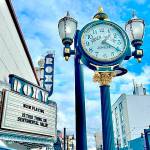
Down the road from the senior center is a vintage street clock also on Front Street. It stands next to a vibrant mural depicting a Viking Ship.
The statuesque ticker was installed by the Poulsbo Rotary Club in 2008 to commemorate the 100th anniversary of the Rotary organization and the City of Poulsbo, according to former Rotary president Dan Weedin.
Reports Mayor Stern, “Over the last 20 years, the clock has become part of the postcard face of Poulsbo, which is our waterfront and historic downtown.”
A few years after being installed, the two-faced timepiece had issues. It seemed to march to the beat of its own drum, never quite in sync with the hours it was meant to keep. Austin came to the rescue.
“It never kept time. One side worked, and the other side didn’t. It looked good, but I guess it was too cheap. It was cast out of aluminum, and it kind of fell apart at the seams. I took it upon myself to have it fixed,” Austin said.
Austin tracked down George Pease, owner of Woodbay Company, a Poulsbo-based clock repair business and considered by some as the region’s “clock wizard.” Pease has an eclectic collection of antique clocks around his property.
“We took the clock down and had it sandblasted and repainted. George did all the work. All I did was come up with the colors and put gold leaf on the clock to make it look smashing,” Austin said.
Port Orchard
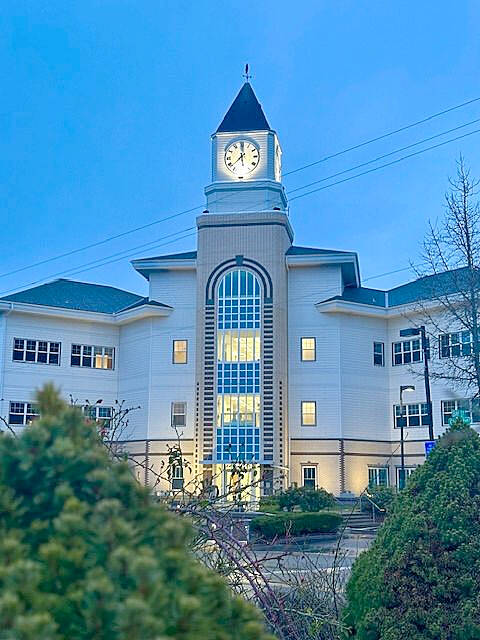
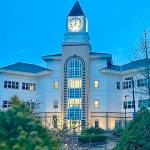
Perhaps the most majestic timepiece of yesteryear in the county sits atop Port Orchard City Hall. The four-sided clock tower overlooks Sinclair Inlet and the city’s waterfront.
“It’s a centerpiece of our downtown,” says Port Orchard Mayor Rob Putaansuu of the clock tower, installed in 1999 when the current city hall was built. “As you are driving into Port Orchard from Gorst, it’s the first thing you see. It’s iconic.”
Putaansuu enjoys hearing the sound of the clock’s chimes. “I live a few blocks from City Hall. Every quarter of an hour, the clock tower tells you the time. When I’m working in the yard, I always know the time. You can hear them for quite a few blocks. It creates a connection,” he said.
City Hall was refurbished two years ago. The project included modernizing the clock.
“When we updated City Hall, we wanted the building to look virtually the same from the street. It was very important to not change the look because our City Hall and clock tower are important to the image of the city,” he said.
The facelift involved digitizing the clocks. “Before, each of the clock faces were controlled manually. We were constantly adjusting time because there are four independent clocks up there. It was a pain in the rear,” the mayor said.
The concept of a clock tower came from then-city councilman John Clauson, now executive director of Kitsap Transit.
While on the council, Clauson attended an architecture workshop. Attendees were shown photos of buildings, many of which were cookie-cutter-style types, while others, like Independence Hall (in Philadelphia), housed a clock, giving them a distinctive presence.
“Part of the rationale of the (seminar) discussion was, when you invest public dollars, try to invest in something that your community can be proud of and really identifies your community. That resonated with me. It made me think of older historic towns where the center focal point of a community was a clock tower at City Hall,” Clauson said.
“I brought the idea back and said, we need to build something so when people see it they’ll know immediately, ‘Oh that’s Port Orchard’s City Hall,’” Clauson said.
Originally, the clock only displayed time. The addition of the chimes that now ring out happened by chance.
Officials held a grand opening event when the new City Hall opened. “We raised a lot of private dollars to fund the celebration. Long story short, when we finished and paid all the bills of the celebration, we had money left over,” Clauson remembered.
The surplus funds were allocated to install the chimes. The melodic tones debuted in December of 1999 at the first Festival of Chimes and Lights event, featuring the lighting of the city’s holiday tree. Chimes and Lights eventually evolved into the current Holiday on the Bay event.
Bremerton
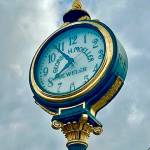
To view antique public clocks, one need look no further than Bremerton. The city boasts two street clocks originally installed in 1928. They once served as advertising tools for local jewelry stores. Today, those who pass them at the right time can watch them being wound up with a large metal key.
The clocks are located at 280 4th Street, in the heart of Quincy Square, next to the Kitsap History Museum, and at 322 N. Callow Avenue, near the art-filled windows of Smitty’s Place Tattoo. The one on 4th was made by Joseph Mayer, a Seattle jeweler and clock builder, while the one on Callow was designed by the E. Howard Company in Boston.
The clocks delight passersby, said Lisa Hope, executive director of the Kitsap History Museum, which owns and maintains the classics.
“These are historical monuments. I always see people stopping and looking at them,” Hope said.
“They have to be wound every week. There’s a real crank we put in and turn. Every time I’m winding it, someone walks by and says, ‘That’s so cool!’ People are always fascinated. They have no idea it’s not automatic,” she said.
George Pease, a Poulsbo-based clock repairman, donates his time to maintain the landmarks. “If you look at old pictures of many towns and cities around the country, you will see these old street clocks. It’s basically taking a bit of that past and bringing it into the future,” he said.
Both Bremerton’s clocks use weight-driven mechanical movements. Long before smart watches, clocks were powered by gravity pulling weights, which transferred energy through the gear train to the escapement, Pease noted.
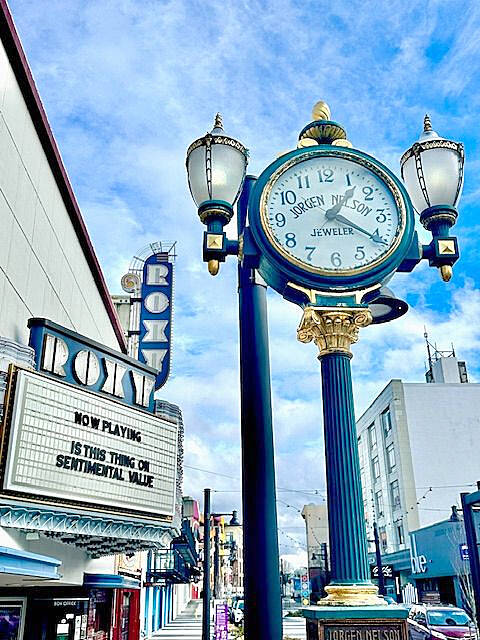
Originally, the clock in Quincy Square was installed in front of the Jorgen Nelson jewelry store on Pacific Avenue, the company that purchased the timepiece, Hope said. It is now referred to by history buffs as the Nelson clock.
The Nelson family donated the vintage piece to the museum in 2000. It was then moved to its current location on 4th Street. Once relocated, it was restored in time for Bremerton’s Centennial, Hope said.
The clock was a source of controversy when the city looked to develop Quincy Square.
“The city wanted to remove the clock. They didn’t think that it was in line with the modern aesthetic that they were going for on the street,” Hope said. “We were not fans of that idea and had to fight to keep it here.”
Once officials learned the cost to move the clock would be hundreds of thousands of dollars, the city backed off, she said.
“It adds to the whole Quincy Square,” she said. “In contrast to the modern street, both sides of the clock have old-fashioned streetlamps attached. At night, it lights up beautifully,” she said.
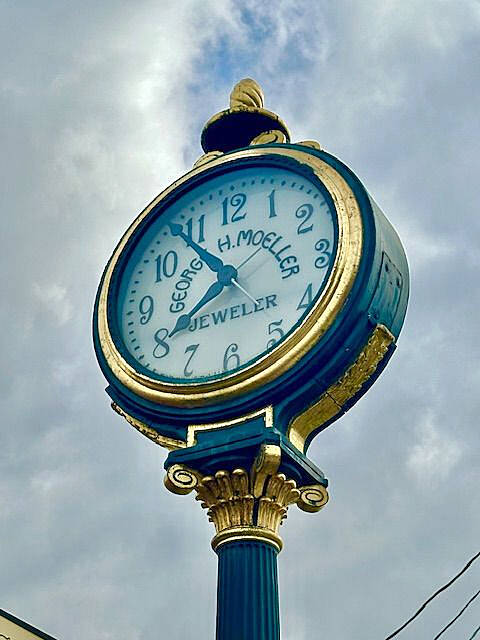
The clock on Callow Avenue sports the George H. Moeller Jeweler name, the business store that originally purchased the clock. First installed on Farragut Street near the shipyard entrance, the clock was moved to Callow Avenue.
The owner of Smitty’s volunteers to keep the clock wound.
Kingston
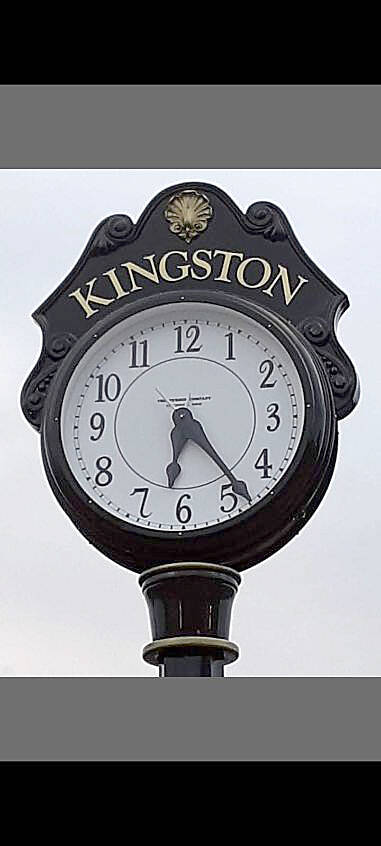
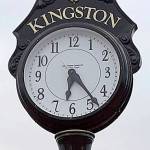
Kingston is home to a retro clock, which stands in Kiwanis Park, near the ferry terminal.
Originally, the unit was installed in the Kingston ferry parking lot in the 1990’s. The clock’s two faces apparently struggled to keep accurate time. The clock was shuttered following complaints that the display of wrong times caused some to miss the ferry. In 2018, Jim Pivarnik, then-Port of Kingston executive director, suggested the clock be restored to become a landmark.
Following restoration work by Pease, the clock was moved to its current location. Featuring a dark green base, the unit announces the town’s name in gold lettering and illuminates at night.
The vintage-style clocks of Kitsap County may not be the primary source of time for folks. Still, they add charm to the neighborhoods by presenting a flair of bygone days.




Best of Kitsap