Stillwaters celebrates decade of community involvement
Published 10:27 am Friday, April 24, 2009
By Kendall Hanson
editor@kingstoncommunitynews.com
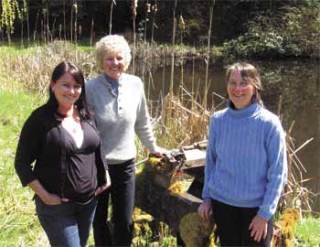
When Joleen Palmer and Naomi Maasberg first moved to Kingston in 1992, they didn’t plan on starting an environmental education center that would become a hub for community involvement. “Originally we saw a need for a meeting center for Seattle businesses where meetings could be held in a natural setting,” Maasberg said.
Although a few meetings were held on their property, Palmer and Maasberg began to realize their skills and knowledge were better suited to development of a nonprofit organization focusing on community involvement and education. “We realized were were living along a unique watershed that encompassed a variety of different ecosystems within a compact area just three miles long,” she said. “At the same time, we could see that future urban development of the area could potentially cause irreperable damage to this unique natural system.”
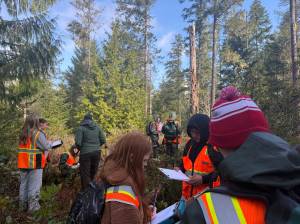
Palmer and Maasberg kicked off the fledgling Stillwaters Environmental Education Center in 1999 with the formation of a group called the Cutthroats of Carpenter Creek, dedicated to finding ways to help maintain and foster the cutthroat salmon population along the waterway by monitoring the stream and later through watershed restoration. “At the bottom of the creek the Carpenter Lake Committee was already doing some work on preserving the lake which is part of the watershed. Our Cutthroat committee quickly blended in with that effort because both groups contained many of the same people,” Maasberg explained. The program is still one of the most important the center coordinates. In 2006, the program was extended to include estuary monitoring, and the resulting data has given the county important baseline data to use in projects such as the Environmental Impact Statement for the proposed Carpenter Lake Bridge on South Miller Bay Road.
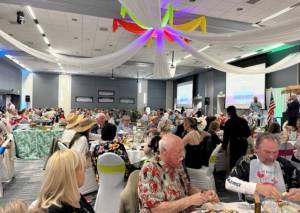
Almost a year after the center was organized, Stillwaters began EcoFest, an event originally intended as a celebration of Earth Day that has morphed into the center’s largest educational event of the year. “It was purely celebration originally,” Maasberg said. “But its educational component has grown every year and although we now have a consistent number of people attending, from 300 to 500, we hope to see the event continue to grow in quality.”
The event has become a centerpiece for community involvement and is now a coordinated with other community groups such as the Kingston Garden Club, Farmers Market and Friends of the Kingston Library. “Initially those other groups were holding events, but we all found people who wanted to go both to the market and then to EcoFest, so we’ve developed a shuttle and other coordination efforts to make it a special day for Kingston,” she added.
After ten years of operation, Palmer and Maasberg have reached some major accomplishments. One of the most important was the Large Woody Debris project in 2007, a major step in the restoration of the watershed, and many smaller, less visible projects such as removal of invasive plants and replanting of native species.
Another of the most visible projects that focused on community involvement was moving the old two-story building at the corner of Lindvog and Highway 104 – the current site of American Marine Bank – to its new home at Stillwaters in 2004. “It was a major undertaking for us and the community,” Maasberg said. “We had to have the foundation in – built entirely through volunteer help – and several other elements in place, including raising the funds. Even though the building was donated, it was expensive to move, and of course, we had to get a variety of permits before it could even go a foot.”
The building will eventually become meeting space and educational space, she said, but for now the original permits only allow it to be used as a storage space. “We still need to do a lot of work –adding plumbing for a bathroom, for example – before we can think about getting it fully re-permitted as a multi-use space,” said Maasberg.
Overall, though, Stillwaters commitment to local ecology has been at the heart of the nonprofit’s work. Recently Joleen Palmer was honored by the state for her commitment to salmon restoration. The Kingston community, however, has honored the organization in its own way by steadily increasing local support through the years.
“Certain Stillwaters has played an important role in the development of the community’s personality,” said Dan Price. “It would be hard to imagine Kingston without Stillwaters and all it represents.”
But Stillwaters is hardly content to rest on its laurels, and Maasberg talks enthusiastically about plans for the future. “We’ve had so many milestones, but there is so much more to do. One of the most exciting projects we have coming up is a ‘re-meandering’ of Carpenter Creek on the Heacock property. We’ll have to do a lot of work to get the stream back to its original course, but it will pay off for both the landowners, the salmon and the natural habitat.”
After all, that’s what Stillwaters is all about.